
Deciding to take the plunge and move to a foreign country can be very daunting. Multiply that by 100 when you've also got the responsibility of deciding what is the best educational outcome for your child(ren).
We've created this guide based on our first-hand experience of schools in Ecuador, supplemented with additional research where required. By the end, you'll understand the different education options in Ecuador & hopefully have a better idea of what may work best for your kid(s) if you move to Ecuador. You can also read our detailed guide on Raising Kids in Ecuador which touches on many important considerations.
Editors note: COVID 19 + Schools
We've created this guide whilst in the middle of the Covid-19 pandemic, but we're mainly calling upon our experiences pre-pandemic. Why? Because like you, we want to get back to enjoying life surrounding by friends and loved ones. This includes our kids being able to physically interact with other kids.
So, whilst a lot of the information provided is still valid during COVID 19, please use your judgment regarding what may or may be available here. For example, there is no school transport available because schools are currently only operating virtually.
How COVID is currently affecting schools in Ecuador
Summary of how COVID is affecting Ecuadorian schools:
Operating virtually only
Some offering a small discount to assist families financially
Schools need to have their COVID protocols in place & approved by COE Nacional
COE Nacional sets the date for classes to start once protocols approved
COE meeting on 9th Feb 2021 to determine whether classes can gradually start operating physically
We'll keep the above updated as more information comes to light.
Related Video: We caught up with vloggers Amelia & JP to talk about our schooling experience in Ecuador.
What types of Schools are available in Ecuador?
I'm just going to say it. The style of education taught in Ecuador does not cater to every child. But, that doesn't mean you can't still make it work. I'll delve deeper into this, but for now, let's get our head around some of the basics.
There are 4 options for educating kids in Ecuador:
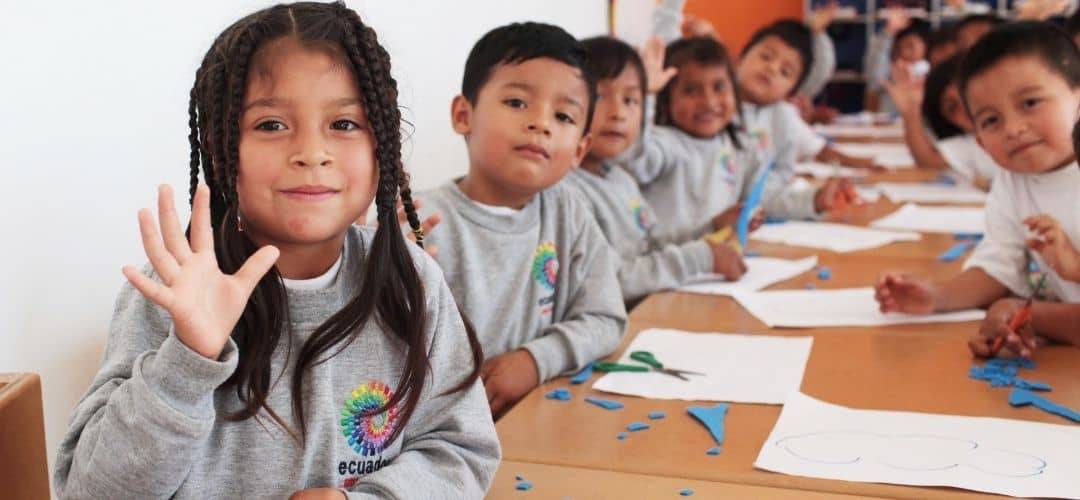
Public schools
Private schools
International schools
Homeschooling
Perhaps you're wondering where the local kids attend? 25% of the Ecuadorian student population go to private schools & 75% go to public schools.
We dive into each of these options below.
1. Public education
The public school system is where the majority of Ecuadorian kids get their education. Like any public system, it's very reliant on the government for funding, syllabus, and teacher quality. You can download the curriculum from the Ministry of Education (in Spanish).
1. Public education
Pros
Cheap. Basic costs are covered (registration & monthly tuition), so you only pay for uniforms, transport & materials such as textbooks.
Cons
Only Spanish taught.
Quality of learning is the lowest of all options.
High teacher rotation.
School infrastructure can be limited and not well maintained.
Availability can be very limited. This is determined based on the region you live in.
Kids need to understand Spanish before enrolling or they'll potentially fall behind.
Can be very strict on absenteeism.
With this option, you're basically trusting the Ecuadorian government to provide learning outcomes that match your child.
This is the only option for many families in Ecuador. But, it's not a very popular option amongst expat students.
We decided against this option for our children because we weren't satisfied that the government could provide the quality of education we'd like. The syllabus tends to be very strict and conservative without having the resources to provide the individual attention we desire.
Best choice for:
Low budget, know Spanish already — Not an option for many expats
We want our kids to be bilingual and reinforcing English at school is a must
— Michelle & Jason · Expats Ecuador
2. Private Schools
This is a popular choice amongst expats and the Ecuadorian middle-class. There are many different private school options available throughout the main cities of Ecuador. These schools have more freedom and resources, but they generally fall short of providing a full bi or multi-lingual learning experience.
2. Private Schools
Pros
Better infrastructure, with some offering quality facilities such as pools
A higher level of education
More willing to use different teaching methods other than mandated by the Ministry
May have connections to schools/universities in other countries
Wide range of after-school activities
More flexibility on kids being absent (they may turn a blind eye to vacations etc whereas government schools only allow absenteeism due to sickness).
Cons
Can be quite expensive ($400 - $800 / month plus materials, matricula & uniforms)
Not truly bilingual. More support for non-Spanish speakers to transition, but classes are still taught in Spanish.
This is the option we originally chose (pre-pandemic) for our kids. The quality of learning was high and we specifically sought out schools that had connections with European sister schools.
Why? Because we wanted to leave the door open to them studying in Spain or other parts of Europe when they're older. Choosing a private school with these connections makes this option become a lot more realistic.
Whilst every private school is different, you also have a much better chance of finding a school that offers a range of after-school activities such as swimming, football, martial arts & dancing.
Most private (and even some public) schools will offer to teach the English language as a subject. But, as this is catered towards Ecuadorian students, you may find that this class is of limited value to your English-speaking child.
The cost is certainly something to consider though, as a fair chunk of our monthly budget was spent on schooling. But, the costs were significantly more affordable than going down the International School route.
Best choice for:
Medium budget with Spanish immersion — Support for transitioning to Spanish!
If you want your kids to learn Spanish this may be a good option. Teachers provide good support for foreign kids to adapt to the Spanish language!
— Michelle & Jason · Expats Ecuador
3. International schools
International schools can be a great landing pad for expat kids that don't yet speak Spanish. These are truly bilingual with classes also offered in English, German or French languages. But, be prepared to open your wallet as these school programs are not cheap.
3. International schools
Pros
High level of learning
Bilingual education, with classes taught in English, German or French languages
Networking - your kiddo can make connections with other 'rich' kids.
Connections with schools in other countries (for university or exchange etc).
Cons
Expensive. Expect to pay $800 to $1000 monthly
Mainly limited to the highly populated cities of Quito, Guayaquil & Cuenca
The curriculums offered at international schools are often based on those from the UK, US, France, or Germany. This can make it considerably easier to transition to other institutions around the globe that are using the same curriculum. This is one of the main reasons international schools are popular with expat families, particularly those that work for multi-national corporations or diplomats.
We've never seriously considered this option because of the cost. With two kids, you're looking at $2k every month just for schooling. This is 5x the minimum salary of Ecuador. Whilst we do see the value of a bilingual school and the networking, the cost would be a considerable drain on our monthly budget & potentially detract from our overall quality of life.
Best choice for:
When money is no object — Hard for us to justify the cost
The cost would be a massive drain on our overall budget & impact our lifestyle too much
— Michelle & Jason · Expats Ecuador
4. Homeschooling
This is largely uncharted territory for your average Ecuadorian. Whilst we may be used to this concept, it's really only because of the pandemic (and the forced homeschooling) that this option is starting to gain momentum in Ecuador. It's a popular option amongst expats, particularly those that live in smaller communities.
4. Homeschooling
Pros
Flexible time management
Complete control over your kids' learning experience
Cheap ($50-100 per month)
Can be done from wherever, whenever
Cons
Not completely recognized by the Ecuadorian government.
Need to go through an established program in another country
Big time & effort commitment required from parents
Concerted effort required to 'socialize' with other kids
Since the pandemic, lots of families (yours included we dare say) have been able to experience what it's like to homeschool. It's a big commitment, but ultimately can be very rewarding.
We started forced homeschooling like everybody else when Covid 19 hit, but we've made the conscious decision to continue homeschooling even when virtual learning through our private school became available.
Best choice for:
Digital nomads or slow-mads — Freedom to explore Ecuador!
Homeschooling gives us the opportunity to explore Ecuador while teaching our kids what's important to us!
— Michelle & Jason · Expats Ecuador
Why we homeschool
You see, Ecuador is not an overly tech-savvy nation. So, when the entire school system was forced to operate virtually, it required a substantial change from everybody. It's been hard for educators to properly adapt. For example, asking a 5-year-old student to sit in front of a Zoom call for 6-7 hours a day just wasn't going to provide the learning outcomes we wanted. We ended up doing most of the educating anyway.
We also weren't completely happy with the ability of the private (or public) system to develop the emotional intelligence of our kids. This is not just an Ecuador (or South America) problem, more so how society has decided how they should be educated. But, I'm comfortable in saying that Ecuador is (and is likely to remain) behind how many developed nations are starting to develop better programs to enhance emotional intelligence.
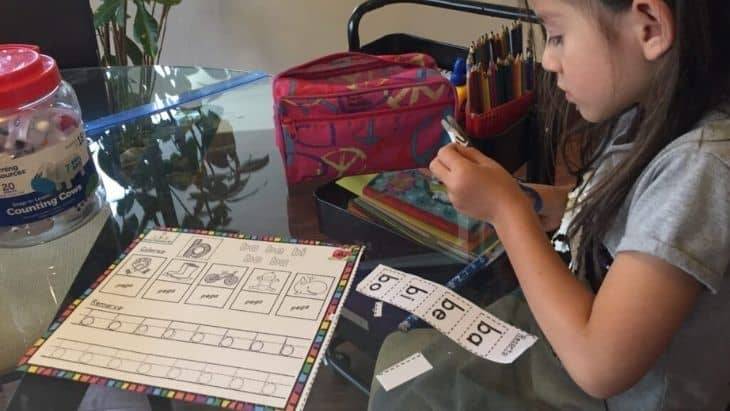
We supplement our teaching with specialist teachers in subjects we don't have the capacity to teach such as robotics & coding.
The freedom provided by homeschooling has been fantastic. We just got back from an extended trip to the beach where we were able to focus on real-world education that just isn't possible any other way. For example, our last class was on how to identify and stay safe in rips and currents. This type of education is not taught anywhere else in Ecuador.
How to homeschool
Because the Ecuadorian Ministry of Education only recognizes homeschooling in extreme situations where access is very difficult (ie indigenous tribes living in the Amazon jungle), you'll need to be comfortable living in a somewhat gray area if you decide to homeschool.
By this I mean you'll need to:
Register your child in an overseas program that can issue a certificate each year stating that your child has passed the relevant grade.
Have this certificate registered with the Ecuadorian Ministry of Education each year if you are considering putting your kids in the system at some point.
By doing this, you're basically working outside of the Ecuadorian curriculum and have complete control to pursue any curriculum you see fit.
Which homeschool programs to use
There are several programs you can use, but the one we use is based in the US. We pay about $300/year for them to handle the paperwork and provide the certificate at the end of each school year.
That amount is only for paperwork and we spend around $40 - $80 monthly for programs or apps we find useful for the learning process of each child. This is on top of after-school activities.
Feel free to get in contact with us for details of the program that we use for our kids.
How much do private & international schools cost?
Glad you asked. We've put together this table showing the registration (matrícula) & monthly (pensión) costs, and calculated the yearly costs based on these.
This is based on enrolling for "General Basica", which is for ages 7-12.
We've included a range of private institutions based on those that are popular with expats and we've also included some which may not be so popular, but they score highly on the standardized testing they use for university admission. Data is taken from the Ministerio de Educacion's official site.
City | Province | School Type | School Name | Registration (Matrícula) | Monthly Fee (Pensión) | Yearly Costs |
|---|---|---|---|---|---|---|
Cuenca | Azuay | Private | Pasos | $113 | $180 | $1,913 |
Cuenca | Azuay | Private | Particular Kennedy | $90 | $144 | $1,530 |
Cuenca | Azuay | Private | Particular American School | $83 | $133 | $1,413 |
Cuenca | Azuay | International | Particular Binacional Colegio Aleman Stiehle de Cuenca | $270 | $417 | $4,440 |
Cuenca | Azuay | International | Particular Santana | $199 | $318 | $3,379 |
Cuenca | Azuay | Mixed | Tecnico Salesiano | $33 | $53 | $563 |
Quito | Pichincha | Private | Frau Klier | $85 | $137 | $1,455 |
Quito | Pichincha | Private | Particular Cardenal Spellman | $136 | $218 | $2,316 |
Quito | Pichincha | International | Colegio Americano de Quito | $469 | $750 | $7,969 |
Quito | Pichincha | International | Albert Einstein | $698 | $1,117 | $11,868 |
Quito | Pichincha | International | Particular Britanico Internacional | $367 | $586 | $6,227 |
Cayambe | Pichincha | Mixed | Domingo Savio | $61 | $97 | $1,031 |
Manta | Manabi | Private | Isaac Newton | $126 | $201 | $2,136 |
Manta | Manabi | Private | Maria Montessori | $58 | $93 | $988 |
Portoviejo | Manabi | Private | Rosa Cedeno de Granizo | $51 | $82 | $871 |
Manta | Manabi | International | Glenn Doman | $155 | $248 | $2,635 |
Manta | Manabi | International | Particular Bilingue Leonardo Da Vinci | $278 | $445 | $4,728 |
Chone | Manabi | Mixed | Cinco de Mayo | $24 | $39 | $414 |
Guayaquil | Guayas | Private | Interamericano CEBI | $132 | $211 | $2,242 |
Guayaquil | Guayas | Private | Boston | $107 | $171 | $1,817 |
Guayaquil | Guayas | International | Menor Santiago de Guayaquil | $570 | $912 | $9,690 |
Guayaquil | Guayas | International | Balanda Cruz de Sur | $384 | $614 | $6,524 |
Guayaquil | Guayas | International | Internacional SEK | $371 | $594 | $6,311 |
Guayaquil | Guayas | Mixed | Fiscomisional Santa Maria Mazzarello | $43 | $70 | $743 |
Data taken from the Ministerio de Educacion's official site.
Additional costs not included in the above table
The above table only includes the basic education costs. There's also a range of mandatory & optional extras that you'll need to factor in that we've included below. These are all going to differ by school, but we've provided a rough estimate for each of these costs. You'll want to confirm with each school what these costs are going to be depending on your preferences and circumstances.
Total monthly costs (including additional costs)
So, let's say you're thinking about moving to Cuenca and want to enroll in the Santana school. Your cost breakdown for the school year will look something like this:
Basic costs (matricula & pension): $3,379
Uniforms: $200
Supplies: $250
Transport: $60 / month ($600 yearly)
Meals: $50 / month ($500 yearly)
1 after school activity: $50 / month ($500 yearly)
Your total costs for one child are $5429.
It's fairly common to offer a discount of somewhere between 10-20% for the second child, so don't be afraid to try and negotiate a little on this.
Education Costs: Cuenca vs Manta vs Quito vs Guayaquil
Education costs can be a key driver for expat families deciding where to settle in Ecuador. Indeed, one of the reasons we decided to move to Cuenca was due to the lower education costs & the impact this had on our overall cost of living in Cuenca.
You can see from the above table of school costs that Quito & Guayaquil are the most expensive in the country. With Cuenca and Manta having considerably lower school costs.
Extra payment at the start of the school year
Ecuadorians receive an additional payment from their employer at the start of the school year. The idea being that this helps families better absorb the costs of the one-off payments required to cover uniforms, textbooks, etc.
Where do Ecuadorian kids attend school?
The public system is the main option for Ecuadorians in all stages of education (pre-school, school, high school, university) according to the last statistics taken in 2010.
Level of Education | Public | Private | Total |
|---|---|---|---|
Pre-school | 81,399 | 27,025 | 108,424 |
School | 2,463,965 | 673,587 | 3,137,552 |
High school | 549,586 | 231,155 | 780,741 |
Superior Education | 427,545 | 292,008 | 719,553 |
TOTAL | 3,522,495 | 1,223,775 | 4,746,270 |
% | 74.2% | 25.8% | 100% |
Data from Ecuador statistics official site
When do schools start & end?
This depends on where you're going to live as different parts of the country have different holidays based on the rainy season. In the Sierra (incl Quito & Cuenca), the main holidays are generally over the months of July & August, with the new school year starting immediately after.
At the coast, they have their main holiday around the months of January & February, with the semester commencing afterwards.
How long is the school year?
10 months.
Public holidays
Ecuador has 11 national public holidays and each province may also have its own. These holidays can certainly add up, giving you plenty of opportunities to explore Ecuador over 3 or 4 day weekends. We generally try to use these holidays for beach time (we live in Cuenca) or to visit areas 2-4 hours outside of Cuenca such as Loja/Vilcabamba, Yungilla & Riobamba etc.
What after-school activities are available?
Many private & international schools offer a range of after-school activities for students. These activities may rotate every semester. Some of the activities offered MAY include:
Football (ie soccer)
Swimming (especially if the school has a pool)
Martial arts
Dancing
Basketball
Scouts/exploring
Chess
The cost for these after-school activities is generally approx $50/month to cover 2 classes per week.
Uniforms
Uniforms are required at most schools in Ecuador, including public & private. You'll generally need to purchase 2 different types of uniforms. The school will provide you with details of where to buy the uniforms from.
1. Casual or day-to-day
This is your standard uniform that the kids will wear most days, including for physical education days. We recommend purchasing at least 2 of everything as you don't want to be washing every day.
2. Formal
You'll also need to purchase a formal uniform that will be dusted off a few times each semester for official functions such as presentations. We only purchase one of these as they aren't used often.
It's also a good idea to label everything with your child's name. This may even be an official requirement of the school.
Textbooks and other material
You might be surprised at the length of the school supply list you're expected to go out and purchase at the start of each year. Yes, we are talking about textbooks, but it's so much more than that.
You'll need to buy a bunch of stuff such as:
Textbooks
Educational toys
Paper
Craft supplies
Toilet paper (yes, you may be expected to provide this)
Most of these items need to be individually labeled (not toilet paper...), which can take a whole day of your time as even the smallest items such as individual lego blocks & pencils need to be labeled.
Even if the school doesn't necessarily mandate labeling everything, it's still a pretty good idea as it acts as a deterrent from other kids stealing or 'misplacing' these items.
You'll need to bring in all of these items on the first day of school.
Transport
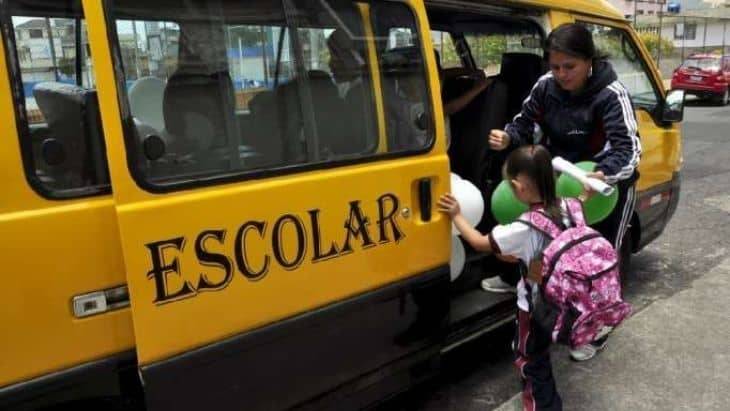
Kids riding the bus in Ecuador. Image: Lahora
Cars are luxuries in Ecuador because they are super expensive (at least 2x you'd pay in the US). This means that transport is offered by most institutions for a fee. How much you pay depends on how close to the school you happen to live.
The bus drivers will generally pick you up from your house and they may also have a chaperone that helps with the organizing - ie calling the parents if the student isn't ready.
Some will organize everything for you, whilst others will simply give you contact details of bus companies that they are affiliated with and it's up to you to organize & negotiate the price directly.
If you're looking for a ball-park figure, expect to pay around $60/month.
Parent committees
There is a strong culture of active parent committees in the primary schools that we've enrolled in. We've been involved as representatives of our child's class and it's a great way to really understand how the school functions behind the scenes. It's also a great outlet for keeping up with all the school gossip...
Be prepared to be designated as President of your kid's class if you are the new parent in town. But if this seems a little daunting, you can always play the gringo card and say "no hablo Español". Being part of the committee does require additional effort and it can be particularly challenging if you end up being responsible for collecting funds from other parents.
Additional participation
Funding is often a topic of discussion, with many schools needing (or choosing) to incorporate various fund-raising initiatives throughout the school year. Your participation in these types of events may even be mandatory. These types of activities may include:
School fairs
Basically a fun day with lots of face painting, sports & delicious food. I honestly love the school fairs because it's a great opportunity to stuff myself with homemade cakes and other food that I wouldn't normally get to try.
Clean up days
Community cleanup days or 'Mingas' are common throughout Ecuador. It's basically where the entire community gets together and gives the place a good tidy up. Your school may recommend or flat out require that you participate in these.
Donations
Sometimes the school will just flat out ask you to donate for a particular cause such as the construction of a new building.
What school year should my child enter?
Ecuador operates slightly differently to the US. With Kindergarten effectively replacing 1st grade. The following table will give you an idea of where your child would generally fit into the Ecuadorian school system.
Basica system (up to age 14 approx)
Grade in US | Year in Ecuador | Age (approx) |
|---|---|---|
Kindergarten | 1 de Basica | 5 |
1 | 2 de Basica | 6 |
2 | 3 de Basica | 7 |
3 | 4 de Basica | 8 |
4 | 5 de Basica | 9 |
5 | 6 de Basica | 10 |
6 | 7 de Basica | 11 |
7 | 8 de Basica | 12 |
8 | 9 de Basica | 13 |
9 | 10 de Basica | 14 |
Bachillerato system (ages 15-17 approx)
Grade in US | Year in Ecuador | Age (approx) |
|---|---|---|
10 | 1 de Bachillerato | 15 |
11 | 2 de Bachillerato | 16 |
12 | 3 de Bachillerato | 17 |
How to register your child in school?
Obviously, this depends on which type of school you're looking to enroll in. At a minimum, you'll need your child's passport (or cedula) and documentation to show which grade they should be enrolled in.
A report card will generally suffice and if there are any doubts, the school may require the child to take a test to ensure they're in the correct grade and won't be left behind. Sometimes an interview with the parents is also required.
Our experience is that most education providers are very hesitant to provide details over the phone or via email, showing a strong preference to only answer questions via a personal appointment. This was very annoying for us when we were moving from Quito to Cuenca as the logistics were very difficult.
Perhaps COVID and its inevitable push towards using video conferencing has allowed them to be more open in accepting video calls instead of in-person appointments, but we can't confirm this. If you're having difficulty making contact by yourself, you can consider using a general facilitator that can do the leg work for you.
Wrapping up & your next steps
We hope this guide has helped answer your questions about schooling & education in Ecuador. Ecuador is a diverse country, and there are bound to be many nuances that are going to differ by each region and school.
Please take in consideration that at the moment schools are only offering online classes to avoid the spread of the pandemic.
Feel free to use this guide as a starting point for compiling your own questions to direct towards each school that you're considering for your child. You're welcome to get in contact if you have any questions and we'll try to respond as accurately as we can.
Photo references:
Public school from El Universo
Private school from Expresso
International school from Colegio Britanico Quito
Homeschooling from El Comercio
Comments from the original site (12)
These comments were posted on the original Expats Ecuador WordPress site and are preserved here for reference. To add a new comment, please message us on WhatsApp.
Shelly Allen-Tucker · Mar 6, 2021
What school would our high school students go? We have 10th and 11th students. I notice your list only goes to 9th grade.
Jason Scott · Mar 8, 2021
Hi Shelly - thanks for pointing this out. I've just updated the post to include another list for grades 10-12 (US). Grades 10-12 (US) use a different system called the Bachillerato. But, most schools offer both Basica & Bachillerato levels, so the kids don't necessarily need to go to a different school once they reach the 10th grade (US).
Leana McClain · Oct 27, 2021
Looking for information about Tomas de Berlanga School in Galapagos. What is school calendar for 2021-2022? Thank you-
Nadine Billard · Dec 6, 2021
Where can I find a list of the textbooks/books required?
Sally · Dec 15, 2021
What day/month does a student need to turn 5 in order to be eligible to start kindergarten?
Jason Scott · Jan 8, 2022
Hey Nadine, each school has its own textbook requirements. You'll need to check with each school.
Emily Griffin · Jan 10, 2022
Hi, we are a family of 4 with kids ages 12 and 9 thinking of spending a year in Ecuador starting this summer. Your post was incredibly helpful, thank you!!!
Jason Scott · Jan 12, 2022
Hey Emily - so glad you got value from it. Sure your kids will love it here.
Arleen DeVivo · Jan 14, 2022
I am a Spanish teacher in AZ asking students to compare the school systems of the U.S. vs. their Spanish-speaking country of study. Can you provide details on the start and end times of public schools - an average would be terrific!
John Wauson · Jan 14, 2022
Can an expat first time Ecuadorian student enter the school system in the last year of school or do they have to attend a minimum of two years in order to graduate?
Donna M · Jul 12, 2022
Your article is excellent. However, we have a 5 year old grandson on autistic spectrum and we haven't been able to find a program for him for this coming school year that has space available. We are in Cotacachi, Imbabura (not far from Otavalo or Ibarra). Any suggestions? We may have to homeschool, but since Covid he has not attended any programs with other children and he needs to be able to socialize. Also we haven't found any programs he could join either. Any schools or programs would be helpful.
Jason Scott · Jul 14, 2022
Hi Donna, unfortunately we don't have this knowledge of schools in the Cotacachi area. We have heard good things about this homeschooling project in the Quito area. Not sure if they are also in Cotacachi etc. https://www.facebook.com/Comunaeducativaec